
Smart Hospitals & Future-Ready Infrastructure
At our upcoming health leadership conference, we're exploring how digital innovations, AI-driven systems, and IoT are reshaping hospitals into connected, efficient, and patient-focused environments.
At our upcoming health leadership conference, we're exploring how digital innovations, AI-driven systems, and IoT are reshaping hospitals into connected, efficient, and patient-focused environments.
A smart hospital system is more than a collection of advanced devices—it is an ecosystem where digital solutions, artificial intelligence, and human-centered design converge. By harnessing health information infrastructure, hospitals are able to connect departments, manage real-time patient data, and provide clinicians with actionable insights that improve outcomes.
The core of a smart hospital lies in its ability to adapt and evolve. This adaptability means hospitals can integrate innovations, from AI-driven diagnostic tools to robotics-assisted surgeries, while ensuring interoperability with existing healthcare data infrastructure. Such adaptability is critical in a rapidly changing world where patient needs, regulations, and global health threats constantly shift.
In practice, smart care hospitals use connected beds, automated medication systems, and remote monitoring devices to optimize care delivery. They minimize errors, streamline workflows, and empower patients to take an active role in their own health journeys. By embedding digital health infrastructure into every layer of hospital operations, institutions can future-proof themselves against challenges ranging from staffing shortages to global pandemics.
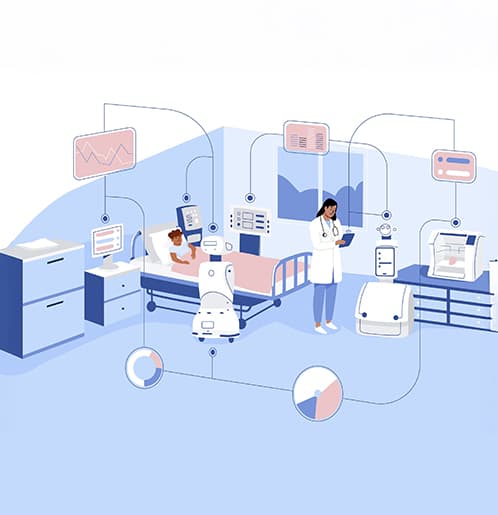
Healthcare is experiencing unprecedented pressures—aging populations, rising chronic conditions, limited resources, and escalating cyber threats. Addressing these challenges requires innovative infrastructure that combines resilience, flexibility, and intelligence.
Together, these factors underscore why the smart hospital of the future is not a luxury—it is a necessity for sustainable, high-quality healthcare delivery.
At our health conference, discussions on smart hospitals will revolve around practical solutions, strategies, and the long-term implications of modernizing healthcare facilities.
Leveraging artificial intelligence to personalize treatment plans, improve diagnostics, and support clinicians in making faster, evidence-based decisions that enhance patient outcomes.
Wearables, sensors, and connected medical equipment provide real-time data streams that improve patient monitoring and connect hospitals to home care environments seamlessly.
Automating administrative tasks reduces staff burnout, ensures smoother workflows, and frees healthcare workers to focus on direct patient interaction and quality care delivery.
Building secure systems to handle electronic health records, research databases, and population health data ensures continuity of care and compliance with regulatory requirements.
Scaling smart hospitals into wider networks of care, enabling collaboration across regions, and ensuring inclusivity in healthcare delivery for all patient populations.
Positioning hospitals as part of larger smart city initiatives that link transport, emergency services, and community care in real time for a more connected healthcare ecosystem.
Presents 100 actionable ideas—from AI-enhanced pricing to automated surgical workflows—to boost efficiency, reduce bottlenecks, and elevate patient experiences. A must-read for hospital leaders and innovators.
Examines both the promise and pitfalls of adopting health information infrastructure in modern healthcare. Wachter highlights real-world lessons that leaders can apply in building smarter, safer hospitals.
An illustrated exploration of sustainable, future-ready hospital design presenting 100 planning and design considerations, accompanied by 28 global case studies spanning children's hospitals and regional campuses.
Conversations with nursing and health tech leaders on how AI and ambient intelligence are reshaping care teams and creating smarter hospital environments.
Features interviews with experts using science, machine learning, AI, and digital innovation to advance healthcare technology from EHRs to translational science applications.
Discusses securing critical hospital systems against downtime and cyber threats, alongside exploring how digital infrastructure impacts patient engagement and resiliency.
Interactive resources for designing smart hospital systems and managing connected infrastructure, with benchmarks to evaluate hospital readiness.
Globally recognized standards for healthcare data infrastructure security and resilience, giving leaders a structured path to assess risks and strengthen hospital cybersecurity.
A platform that supports integration with IoT devices and ensures secure medical device connectivity, assisting manufacturers in meeting compliance requirements for hospital networks.
Smart hospitals enhance efficiency and patient outcomes by embedding AI patient care, IoT monitoring, and automated systems. From quicker diagnostics to personalized treatment, these advancements make healthcare safer and more reliable.
Both. Expect case studies of the best smart hospitals that demonstrate real-world integration of digital health infrastructure, as well as discussions on emerging frameworks and future technologies.
Patients benefit from secure access to their records, faster service, and better coordination across facilities. A robust healthcare data infrastructure ensures continuity of care and improved patient experiences.
Absolutely. Our health leadership conference highlights startups building cutting-edge solutions in smart hospital technology, IoT integration, and administrative platforms.
High-resource regions often focus on advanced AI patient care and connected smart city hospital projects, while emerging economies prioritize affordable, scalable digital health infrastructure solutions.
Please visit our registration page for the latest pricing and package details.
The Health 2.0 Conference is held across multiple global locations including Las Vegas, Dubai, and Singapore. Check our events page for dates and venues.
We accept several payment methods prior to the conference, including VISA, Mastercard, American Express, Maestro, Discover, Bank Transfer, and PayPal. For your convenience, we also have an interest-free installment plan in place. Please contact the team for more information.